


Fixed Bridges Restore Dental Health
Missing teeth can impact more than just your appearance—they can affect your ability to chew, speak clearly, and maintain proper alignment of surrounding teeth. At Smith & Co. Dental Practitioners in Bel Air, MD, we offer fixed dental bridges as a reliable, long-term solution for restoring your dental health and smile.
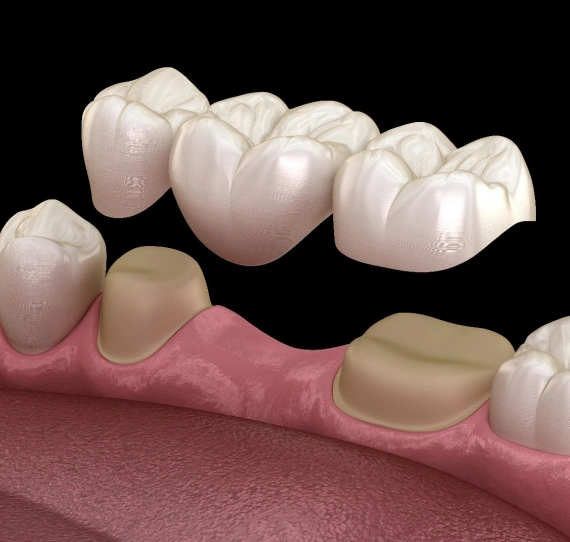
A dental bridge is a custom-made restoration that replaces one or more missing teeth by anchoring artificial teeth (called pontics) to the natural teeth on either side of the gap (known as abutment teeth). Fixed bridges are securely cemented in place, offering a stable, permanent solution that looks and functions like your natural teeth.
Fixed bridges are applied by either placing crowns on the abutment teeth or by bonding the artificial teeth directly to the abutment teeth. Removable bridges are attached to the teeth with metal clasps or by precision attachments.
If you’re missing one or more teeth, you may be aware of their importance to your appearance and dental health. Your teeth work together for many daily functions from eating to speaking. With missing teeth, it’s difficult to do these things. Missing teeth can and should be replaced. Fixed bridges are a great way to restore your dental health and appearance.
What exactly is a bridge or fixed partial denture?
A bridge (fixed partial denture) is a device, which fills the gap where teeth are absent. Fixed bridges are bonded into place and can only be removed by a dental professional. Removable bridges, as the name implies, can be taken out and cleaned. Fixed bridges offer more stability than their removable counterparts.
Why do I need a bridge?
Oral functionality and appearance are important reasons for wearing a bridge. A bridge helps support your lips and cheeks. The loss of a back tooth may cause your mouth to sink and your face to look older.
Dental health is the most important reason for a bridge. Teeth were designed to complement each other. Unusual stresses are placed on the gums and other oral tissues when teeth are missing, causing a number of potentially harmful disorders.
Increased risk of gum disease has proven to be one of the worst side effects of missing teeth and can be minimized with a bridge.
Missing teeth can cause speech disorders as they are used to make many of the sounds we use to speak clearly.

How is a bridge attached?
The attachment procedure usually takes two or three appointments to complete. At the first appointment Dr. Smith will prepare the teeth on either side of the gap by removing a portion of the enamel and dentin.
Since the bridge must be fabricated very precisely to ensure correct bite and to match the opposing tooth, digital impressions of the teeth are taken and sent to a lab where the bridge will be constructed.
Fixed bridges are typically cemented to the natural teeth next to the space left by the missing tooth. A pontic (false tooth) replaces the lost tooth. Crowns, which are cemented onto the natural teeth, provide support for the bridge.
What materials are used?
Bridges can be constructed from gold alloys, non-precious alloys, porcelain, or a combination of these materials. Porcelain is often bonded to either precious or non-precious metal.
How do I take care of my bridge?
A strict regimen of brushing and flossing will keep the bridge and surrounding teeth clean. This is of critical importance as the bridge relies on the neighboring teeth for support.